
Pumping, storing milk and going back to work
In short
A pump is a tool, not a requirement. It earns its place when you are away from your baby, when someone else gives a bottle, or when a medical situation calls for it. What you pump is not a measure of what you make. This guide covers choosing a pump, flange fit, hand expression, storing milk safely in the Netherlands and Belgium, and your rights at work.
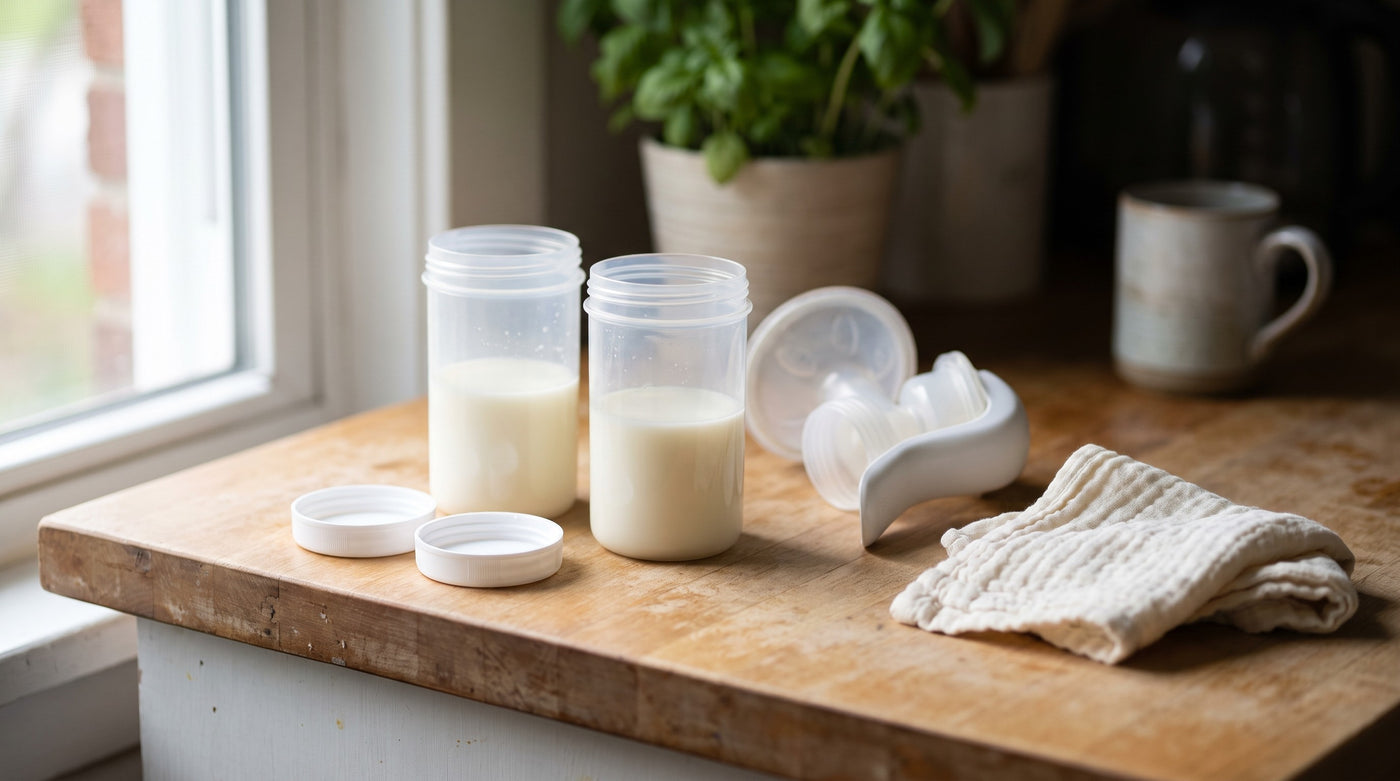
The pump is where breastfeeding turns into logistics. Suddenly there are parts to wash, bottles to label, a bag to pack, a fridge at work you would rather not think about, and a number in the bottle that you read as a school report on your own body.
It is not one. A pump is less efficient than a baby, and your let-down knows the difference. Mothers with a full supply routinely pump modest amounts, and mothers who pump a lot are not necessarily making more. The bottle measures the pump, not you.
This is the overview of the practical side: which pump and which flange size, when hand expression beats a machine, collecting rather than pumping, how long milk keeps in the fridge and the freezer under Dutch and Belgian guidance, and what the law says about expressing at work.
Choosing a pump, and getting the flange right
Most pumping pain is not the pump. It is the flange, the funnel that sits against your breast, and the standard size that comes in the box fits far fewer women than you would think. Too large and it pulls areola into the tunnel. Too small and it rubs the nipple raw at every cycle. Either way you get sore, and you get less milk.
Measure your nipple, do not eyeball it, and expect the size to change over the months. After that the choice is about your life: single or double, hospital grade, wearable in a bra, and how much cleaning you are willing to do at eleven at night.

How you express: by hand, exclusively, or before birth
Hands are underrated. In the first days, when there is thick colostrum and only drops of it, hand expression gets more out than any machine, and it costs nothing to learn. Later it is the fastest way to soften an areola so a baby can latch onto a full breast.
Exclusive pumping is its own path, chosen or not, and it deserves better than being treated as a fallback: a schedule that protects your supply, a way to manage nights, and permission to stop when it is costing more than it gives. Expressing colostrum before the birth is only for specific medical reasons, and only after talking to your midwife.
 Exclusively pumping and giving the bottle: how do I keep my milk supply up?You're sitting at the pump for the umpteenth time that day, watching the bottle slowly ...
 Can you hand express without a pump, and is it safe to express before the birth?You've read somewhere that you can express milk and your mind shot straight to the shop...
Catching milk rather than pumping it
A silicone catcher on the other breast while you feed, or a shell inside your bra, looks like free milk. Sometimes it is. But there is a line here that catches a lot of mothers out.
Passively catching what would have run out anyway is a different thing from actively drawing milk out, which is a signal to make more, and it is one of the quiet routes into oversupply. If you are already leaking heavily, adding suction to the other side every feed can dig you in deeper. Catch the drops, do not farm them, and if you are trying to build a freezer store, do it deliberately rather than by accident.

Storing milk, and keeping the kit clean
Storage advice differs by country, which is why the internet contradicts itself here. Dutch guidance from the Voedingscentrum is stricter than the American figures you will find first in a search, and Belgian guidance is again its own thing. We give both, plainly, rather than an average of the two.
The principles hold everywhere: cool it fast, store it at the back of the fridge and not in the door, label it with the date, thaw it in the fridge and use it within a day once thawed, and never refreeze. Bottles and pump parts get taken apart, washed and air dried, every time.

Pumping at work
Going back to work is where breastfeeding runs into a calendar. In the Netherlands and in Belgium you have a legal right to time and to a proper, private space, and knowing exactly what that right says before you have the conversation with your manager changes the tone of it entirely.
The rest is planning: a rhythm that roughly follows your baby's feeds, a bag you do not have to think about, a fridge or a cool bag, and a plan for the day when a meeting overruns and you are full and starting to leak through your shirt. That last one is where our nursing bra quietly does its work.

Handy tools
When to get it checked
Comfort advice never replaces a look from someone who can examine you. Contact your GP, midwife or a lactation consultant if you notice any of the following:
- a fever or a fluey, run-down feeling alongside a breast complaint;
- a red, warm, painful breast;
- symptoms that get worse quickly;
- a hard spot or lump that does not ease after a feed or after a few days;
- cracked, bleeding or infected nipples that will not heal;
- unusual nipple discharge: one-sided, bloody, or with a strange colour or smell.
With a fever or a red, painful breast, your GP or midwife comes first. For feeding support, a lactation consultant (IBCLC) or your health visitor can help.
Common questions
-
Do I need a pump at all?
Not automatically. If you feed at the breast and you are not going back to work soon, many mothers never need one. A pump earns its place when you are separated from your baby, when you want a store so someone else can give a bottle, or when a medical situation calls for it. Pumping without a reason mainly adds work, and it can push your supply up. -
Does the amount I pump show how much milk I make?
No, and this is one of the most damaging misunderstandings in breastfeeding. A pump is less efficient than a baby at the breast, and your let-down responds less readily to plastic than to your child. Plenty of mothers with a full supply pump modest amounts. Judge your supply on your baby's growth and nappies, not on what you see in the bottle. -
When should I start pumping before going back to work?
Around two to three weeks before you start is enough for most mothers. That gives you time to build a small store without pushing your supply up early, and time to find out whether your baby will take a bottle at all. Once you are back, expressing at roughly the times your baby would feed keeps both supply and comfort steady. -
Can I combine breastfeeding and bottles without losing my supply?
Yes, plenty of mothers do. Supply follows removal, so the more feeds you replace with a bottle without expressing, the more your body scales back. If you want to hold your supply where it is, express around the feeds you miss. If you want it to come down gently, drop feeds one at a time rather than all at once. -
Do I have the right to pump at work in Belgium and the Netherlands?
Yes in both, though the rules differ. In the Netherlands your employer must provide a suitable private space and paid time to feed or express during working hours for the first nine months, up to a quarter of your working time. In Belgium you have a right to breastfeeding breaks, compensated through your health insurance fund rather than by your employer.
Alejandra & Jurgen
We write from recognised guidelines and from what mothers tell us themselves. The sources we rely on are listed below.
Sources
All articles in this guide (6)
- Exclusively pumping and giving the bottle: how do I keep my milk supply up?
- Can you hand express without a pump, and is it safe to express before the birth?
- Which breast pump is right for me, and how do I know the flange fits?
- Milk collector, Haakaa or Ladybug: which one is right for you?
- Going back to work and dreading the pumping conversation: what you're entitled to, and how to fit it into your day
- The storage times for expressed milk are different everywhere I look: which one is for me, and when does the clock start?