
Leaking breast milk and staying dry
In short
Almost every mother leaks in the early months, most heavily in the first six to twelve weeks, and most often at night. It comes from the let-down reflex, not from doing anything wrong, and the amount says little about your supply. It usually settles as your body tunes to your baby. This guide covers why it happens, how long it lasts and how to stay dry.

Nobody tells you about this part. You feed on one side and the other side simply runs. You hear a baby cry in a shop, not even yours, and you feel that tingle come up. You wake at three in the morning and your shirt is cold and wet against your skin, again.
Then comes the question almost every mother types into her phone in the dark: is this normal, is this too much, or is something wrong. The honest answer is that leaking is nearly always your body working, and that the range between mothers is enormous. One woman is dry after six weeks. Another leaks through her top at every feed for months. Both are feeding a thriving baby.
This is the overview of everything we cover on leaking: why it happens, what is normal at each stage, what to do at night, what to do when it is a lot, when it stops, and the few signs that belong with a doctor rather than a towel.
Why you leak, and what counts as normal
Leaking is oxytocin doing its work. When your breast gets the signal to release milk, tiny muscle cells around the milk glands squeeze, milk moves towards the nipple, and whatever cannot leave through your baby simply runs out. Your brain releases that oxytocin for your baby, but also for anything it has learned to link with feeding: a cry, a photo, a warm shower, a breast that has been full for a while.
That is why it arrives at moments that have nothing to do with a feed, and why it is heaviest in the weeks when your body is still making milk in stock rather than to order.

Leaking at night
Nights are the worst of it for most mothers, for one plain reason: the gap between feeds is longer, so your breasts are fuller when the let-down comes. Sleeping on your front makes it worse, and so does the first stretch of sleep your baby finally gives you.
Two things decide whether you wake up dry. Something absorbent that stays exactly where you put it while you turn over, and support that holds without pressing anywhere, because steady pressure on a full breast is not what you want overnight. A towel on the sheet works. It just is not a plan you want to keep for six months. What to wear in bed sits with the nursing bra and fit guide.

When it starts, and when it stops
It can start before your baby does. Drops of colostrum in the second half of pregnancy are normal, and so is leaking nothing at all: neither one predicts how much milk you will make.
After the birth, the peak arrives with the milk itself, roughly day two to six. From then it is a slow curve. Supply usually settles to your baby somewhere between six and twelve weeks, and for many mothers the leaking drops off sharply around that point. For others it carries on well past six months, at night or during let-down. There is no schedule you are behind on. The spread is the answer.
 How long will I really keep leaking? 6 weeks, 3 months or 6+ months: the honest rangeSomewhere on a forum sits a mother who has been feeding for 6 months and still wears br...
 I'm leaking fluid from my breasts in pregnancy: is colostrum leaking normal, and does it mean anything if it doesn't happen?You're halfway through your pregnancy, or you're already in the final stretch, and you ...
 When will my breasts finally stop leaking? And why does none of the numbers online seem to fit me?It's gone half one in the morning and you're back on your phone. The baby's finally asl...
When it is a lot: catching, absorbing, relieving
Heavy leaking has one trap in it, and almost every forum walks straight into it. Emptying your breasts to stop the leaking tells your body to make more, so the next day is worse. The way out runs the other way round.
First, absorb and catch, because that costs your supply nothing. Second, relieve only enough to take the edge off when a breast is painfully full, not until it is soft. Third, look again if it is not really about catching milk any more: a baby choking on a forceful spray, or breasts that stay full and painful, is a different question with a different answer.

A let-down that arrives off duty
Your body has one button for this, and it does not ask what you are doing. So milk arrives during sex, when you sneeze, in the shower, when you laugh, when someone else's baby cries three tables away. Months after the last feed, a hormone surge can still bring a few drops.
It is normal, it is more common than anyone admits out loud, and the awkwardness is nearly always a first-time thing that fades. Feeding or expressing before an evening you care about helps. So does saying it out loud once, which is usually the end of it. More on how this lands in everyday life sits in the body and daily life guide.

After you stop feeding
Leaking does not switch off on the day of your last feed. Supply winds down over weeks, and a little fluid can appear now and then for a while after that, sometimes for months if you stopped quickly. That is usually your body finishing what it started.
What does not belong to that picture is discharge that comes from one breast only, that is bloody, or that has an unusual colour or smell, and a hard spot that does not ease. Those are worth a doctor's look, whether you are feeding or long finished. How to wind down without engorgement sits in the transitions guide.
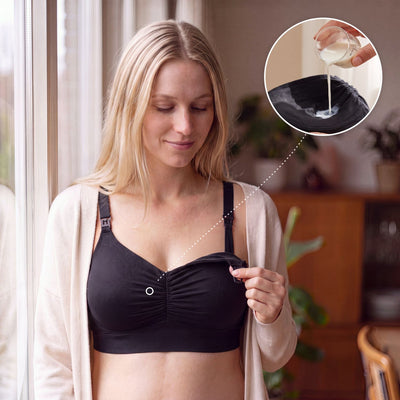
Staying dry without thinking about it
Leaking becomes manageable the moment the absorption stops moving around. That was the whole reason we built our nursing bra the way we did: the absorbent layers sit inside the cup itself, instead of loose against your skin. Four layers, each with one job. One draws moisture away from the skin, a core holds up to 30 ml per cup, a barrier keeps it off your shirt, and a soft outer layer sits against you. No wire, a clip that opens one-handed, and an OEKO-TEX Class I certified fabric (certificate 11-36224), the strictest category for textiles that touch a baby's skin.
View the braWhen to get it checked
Comfort advice never replaces a look from someone who can examine you. Contact your GP, midwife or a lactation consultant if you notice any of the following:
- a fever or a fluey, run-down feeling alongside a breast complaint;
- a red, warm, painful breast;
- symptoms that get worse quickly;
- a hard spot or lump that does not ease after a feed or after a few days;
- cracked, bleeding or infected nipples that will not heal;
- unusual nipple discharge: one-sided, bloody, or with a strange colour or smell.
With a fever or a red, painful breast, your GP or midwife comes first. For feeding support, a lactation consultant (IBCLC) or your health visitor can help.
Common questions
-
Is leaking a sign that breastfeeding is going well?
Not in either direction. Leaking shows that your let-down reflex is working and that milk is being released, but it does not measure how much you make. Plenty of mothers with a full supply barely leak, especially after the first months. What tells you feeding is going well is your baby: steady growth, wet nappies, and calmer after a feed than before it. -
How much milk do you actually lose when you leak?
Far less than it feels like. A wet shirt looks dramatic, but the milk that leaks is small compared with what your baby takes at a feed, and your body simply makes it again. You do not need to make up for it by pumping extra. Doing that tends to prompt your body to make more, and then you leak more. -
Can I still leak if I only pump and never feed at the breast?
Yes. Leaking follows the let-down reflex, and that reflex answers to hormones, not to the way the milk leaves. If you pump exclusively you can still leak between sessions, especially when a session runs late, when you hear a baby cry, or in a warm shower. It usually settles once your pumping rhythm becomes predictable. -
Can leaked milk make my clothes or bra smell?
It can, the way any milk left to dry does. Dried breast milk in fabric can turn slightly sour, particularly in warm weather. Changing a wet layer in good time helps, and so does rinsing bras in cold water before a normal wash. Hot water tends to set milk into the fibres rather than lift it out. -
Does drinking less water reduce leaking?
No, and it is not worth trying. Your body keeps making milk whether you are well hydrated or not, so cutting back on fluids mainly leaves you thirsty, headachy and more tired than you already are. Leaking is driven by the let-down reflex and by how full your breasts are, not by how much you drink. Drink to thirst.
Alejandra & Jurgen
We write from recognised guidelines and from what mothers tell us themselves. The sources we rely on are listed below.
Sources
All articles in this guide (7)
- Why do I leak milk during sex, and at moments that have nothing to do with feeding? Is that normal?
- How long will I really keep leaking? 6 weeks, 3 months or 6+ months: the honest range
- I'm leaking heavily all day long: should I let it soak in, catch it, or just let some run out?
- I'm leaking fluid from my breasts in pregnancy: is colostrum leaking normal, and does it mean anything if it doesn't happen?
- When will my breasts finally stop leaking? And why does none of the numbers online seem to fit me?
- Night leaks: what to wear in bed without leaking through
- Why are my breasts leaking? Causes, triggers and what's normal