
Nursing bras: choosing, measuring and staying comfortable
In short
A nursing bra has three jobs: hold you comfortably while your breasts change, open with one hand while you feed, and deal with the milk that leaks. Most bras manage the first two. The size you wore before pregnancy rarely fits now, and it will change again. This guide covers fit, leak protection, pads, fabric and which bra suits which moment.
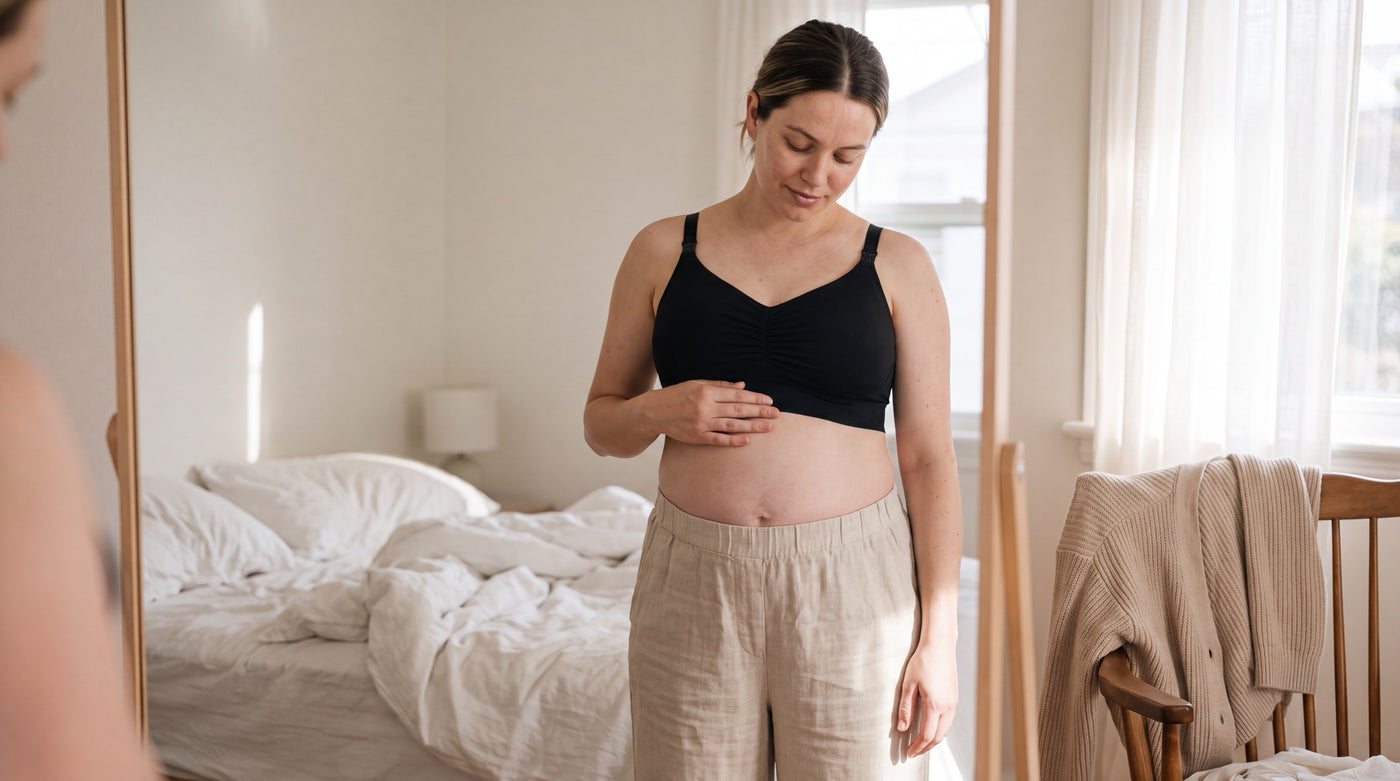
You end up buying the wrong bra twice. Once in month five of the pregnancy, when your cup is nowhere near where it will land. And once in the first week at home, in a rush, because the one you have digs in and takes two hands to open while you are holding a baby who has waited long enough.
A nursing bra is a strangely demanding piece of clothing. It has to support breasts that change size within a single day, open in one movement while you are already sitting down with the baby, sit soft against skin that is tender, and cope with milk arriving at the wrong moment. Most bras solve one of those and leave you with the rest.
This is the overview of everything we cover on bras: what leak-proof really means, how to measure while your size is still moving, bra against pads, what to wear at night, at work and while pumping, and the fabric and details that decide whether you forget you are wearing it.
Bras that actually keep you dry
The word leak-proof gets used for two very different things. A bra that holds a loose pad in place, which is really a bra with a pocket. And a bra with the absorption built into the cup, where there is nothing to slip, roll or land half out of place at the worst moment.
Both keep a shirt clean on a light day. The difference shows on a heavy one, and at night, when you are asleep and cannot correct anything. What to look for: where the absorbent layer sits, how much it holds, whether a barrier layer stops the wet reaching your top, and whether the wet layer stays away from your skin.
 Which nursing bra is best in 2026? How to compare brands and types honestlyYou type "best nursing bra 2026" into the search bar and up comes a list of ten. Stars ...
 Which nursing bra is truly leak-proof? How to compare absorbent optionsYou're on your phone in the evening, scrolling. Breast pads, an absorbent nursing bra, ...
Size and fit while everything is still changing
Measuring is not the hard part. The hard part is that you are measuring a moving target: fuller after a long night, softer after a feed, different again once your supply settles. Which is why buying your final feeding size in the fifth month of pregnancy rarely works out.
The rules that hold up: the band does the supporting and should sit level, not ride up. Nothing should press into one spot, and red marks or dents are a warning, not a sign of good support. Cup room needs to allow for a breast that fills up. And if you are between sizes, comfort in the band wins, every time.
 Sister sizing for a nursing bra: when your size falls right between twoYou bought it a size up and the band still digs into your back. You take it off in the ...
 When to buy a nursing bra: while pregnant, or after the birth?You're heavily pregnant and you want everything ready. The hospital bag is packed, the ...
 Is my nursing bra too tight? How to tell it's digging inYou're counting down. Two more hours and it can come off. And you know exactly what you...
 What nursing bra size am I now, and how do I know it fits without pinching?You're standing in front of the mirror, or scrolling through a shop with a nursing bra ...
Bra or breast pads
This is the most practical question of the whole first year, and it is really three questions. Does it hold enough. Does it stay where you put it. And what does it cost you over the months, in money and in laundry.
Pads are cheap to start, easy to carry and easy to swap when they are soaked. They also shift, roll and go through the wash in their hundreds. Absorption in the cup does not move, but you need enough bras to rotate them. Most mothers end up with a mix, and use each one where it is genuinely better. Why leaking is heaviest when it is: see the guide to leaking and staying dry.
 Washable or disposable breast pads: which is really cheaper, and better for the planet?You're standing in the shop, or scrolling through a website, and you do the sum everyon...
 Breast pads: which ones do you actually need, and do you need them at all?They're on every hospital bag list, somewhere between the maternity pads and the nipple...
 Nursing bra or breast pads: what actually stops you leaking through?You hear the same thing everywhere. Breast pads are the cheap fix, and a bra that absor...
Which bra for which moment
One bra does not carry the whole day. Night asks for support that never presses, and absorption that survives you turning over. Work asks for a smooth line under a shirt, a clip you can open without looking, and enough capacity to get through a meeting. Pumping asks for hands-free access. Sport asks for firm support that still does not squeeze one area.
And after weaning, plenty of mothers want no structure at all, though they still leak for a while, which catches people out. Sorting the day into those moments is quicker than searching for one perfect bra that does everything.
 Going braless after weaning: staying comfortable and dry when you stop breastfeedingThe bra is the first thing to come off the moment you're home. It's about the first thi...
 Which nursing bra for which moment? Night, work, sport, expressing and a bigger cupOn a parenting forum, a mum-to-be asks it like this: "Anyone got tips for THE nursing b...
Fabric, clips and the details on your skin
Nipples are tender in this stage, sometimes cracked, and they are against fabric all day. Which makes the material a comfort question, not a luxury one: breathable, soft, low friction, and a wet layer that does not stay pressed against the skin.
The engineering matters as much. A clip you can open with one hand, because the other one is holding a baby. Wide straps that spread the weight of a full breast. No wire, or at least nothing that digs in when the cup fills. A band that gives as your ribcage changes. These are the details you never notice when they are right, and cannot ignore when they are wrong.
 Big cup: can a wire-free nursing bra really support you?You have always had a bigger cup, and now, after the birth, your breasts are fuller and...
 My nipples are so sore even my shirt hurts: which fabrics help and which make it worseYour nipples aren't sensitive. They're broken. And the cruel part is that the feed itse...
The bra we ended up building
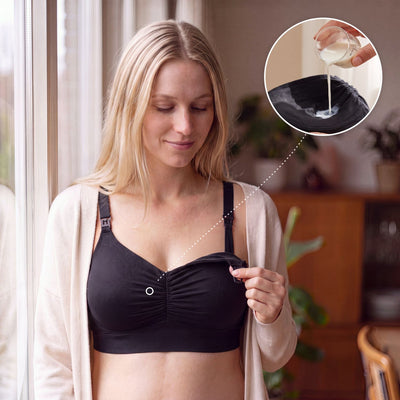
We went looking for one bra that fed and stayed dry, and there wasn't one. So we made it. Support without a wire, a clip that opens with one hand while you hold the baby, a band that gives as your ribcage and cup keep changing, and the absorption knitted into the cup rather than tucked in loose. The core holds up to 30 ml per cup, 60 ml across the bra. The fabric is OEKO-TEX Class I certified (certificate 11-36224), the strictest category for textiles that touch a baby's skin. Designed in Belgium, knitted in Türkiye.
View the braWhen to get it checked
Comfort advice never replaces a look from someone who can examine you. Contact your GP, midwife or a lactation consultant if you notice any of the following:
- a fever or a fluey, run-down feeling alongside a breast complaint;
- a red, warm, painful breast;
- symptoms that get worse quickly;
- a hard spot or lump that does not ease after a feed or after a few days;
- cracked, bleeding or infected nipples that will not heal;
- unusual nipple discharge: one-sided, bloody, or with a strange colour or smell.
With a fever or a red, painful breast, your GP or midwife comes first. For feeding support, a lactation consultant (IBCLC) or your health visitor can help.
Common questions
-
Can I wear a normal bra while breastfeeding?
You can, though most mothers give up on it quickly. A regular bra has no opening, so every feed means pulling fabric out of the way, and a wired cup rarely follows breasts that change size several times a day. If it fits without pressing anywhere and you can feed in it comfortably, there is no rule against it. -
Do I have to wear a bra at all while breastfeeding?
No. There is no medical reason to wear one, and going without does not harm your supply or your breasts. Most mothers still do, for support when their breasts are full and heavier than usual, and above all to hold something absorbent in place. Comfort decides this, not rules, and it can change from week to week. -
Can a tight bra cause a blocked duct?
Steady pressure on one part of the breast is not helpful, and a firm wire, a band that digs in or a bra you have outgrown can contribute to a sore, blocked spot. It is rarely the whole cause on its own. If a hard, painful area does not ease, or you start to feel unwell, have it looked at rather than only changing your bra. -
How do I wash a nursing bra so it keeps absorbing?
Wash cool and skip the fabric softener. Softener leaves a coating on the fibres that repels liquid, which is exactly what you do not want in an absorbent cup. A gentle wash, a low spin and air drying keep both the elastic and the absorbent core working for longer. Tumble dryers age both of them faster. -
How long can I keep wearing a nursing bra after I stop feeding?
As long as it is comfortable. Many mothers keep wearing one for weeks after the last feed, because leaking can carry on for a while and breasts stay tender as they settle. There is no point at which you have to switch back. Your size will keep shifting for a few months, so buy replacements only once it has settled.
Alejandra & Jurgen
We write from recognised guidelines and from what mothers tell us themselves. The sources we rely on are listed below.
Sources
All articles in this guide (13)
- Going braless after weaning: staying comfortable and dry when you stop breastfeeding
- Washable or disposable breast pads: which is really cheaper, and better for the planet?
- Big cup: can a wire-free nursing bra really support you?
- Which nursing bra is best in 2026? How to compare brands and types honestly
- Sister sizing for a nursing bra: when your size falls right between two
- My nipples are so sore even my shirt hurts: which fabrics help and which make it worse
- When to buy a nursing bra: while pregnant, or after the birth?
- Which nursing bra for which moment? Night, work, sport, expressing and a bigger cup
- Breast pads: which ones do you actually need, and do you need them at all?
- Is my nursing bra too tight? How to tell it's digging in
- Nursing bra or breast pads: what actually stops you leaking through?
- What nursing bra size am I now, and how do I know it fits without pinching?
- Which nursing bra is truly leak-proof? How to compare absorbent options